Lifespan AI at AI in Health
The “Bremen Symposium AI in Health” took place for the fourth time. On November 27, 2025, around 120 participants from the fields of science, medicine,
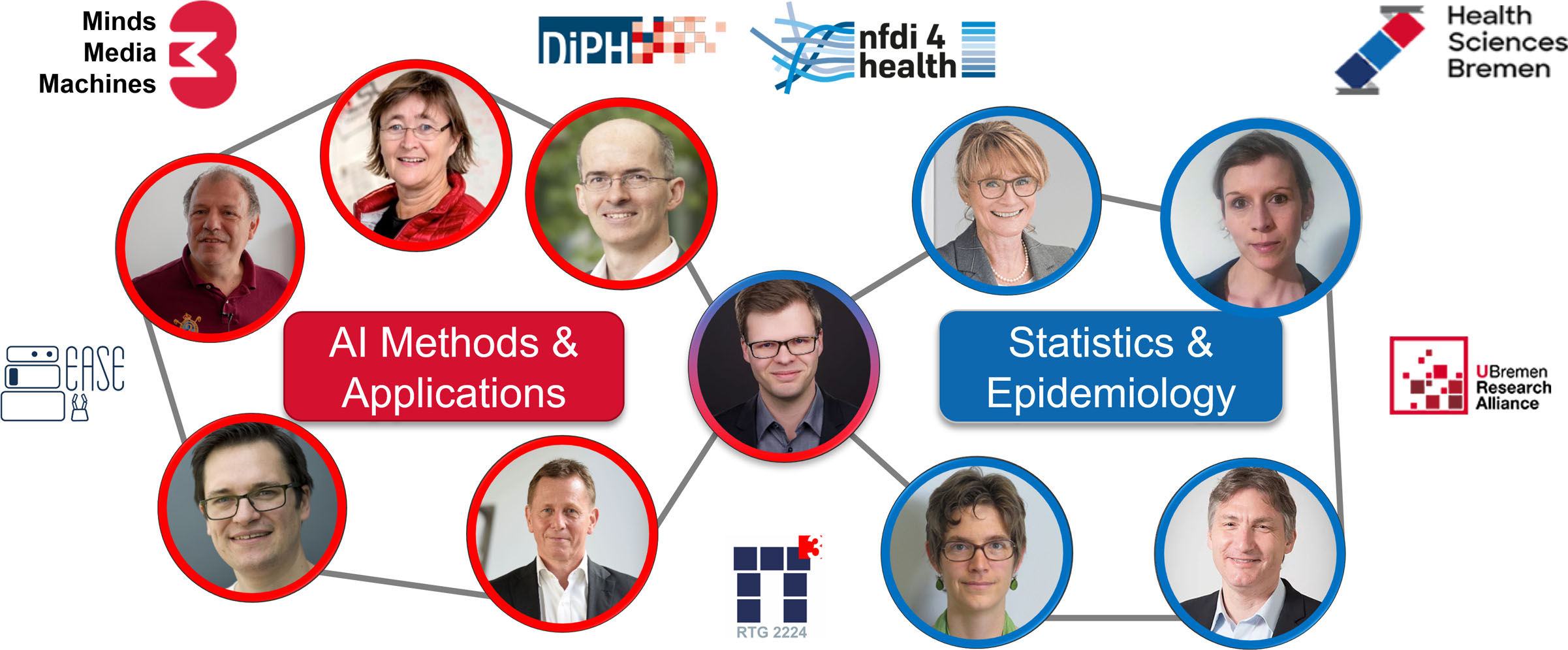
The digital revolution is changing our world. Digital devices, sensors, and technologies casually acquire our data while evolving with us – so, digital natives leave a rich trace from the cradle to the grave. We believe that such collections of bio, social, and lifestyle signals will soon complement longitudinal studies, to improve healthcare through precise and personalised prediction, early prevention, and targeted intervention guided by causal inference. We are convinced that the massive influx of health data in combination with recent advancements in artificial intelligence (AI) holds great potential to transform the health sciences.In this research unit, we envision to advance AI methods and tools to model, predict, and explain health outcomes from multi-dimensional data that span the entire life. We aim to responsibly use unique data sources to extract relevant knowledge, to advance deep learning models, and to perform causal discovery with the ultimate goal to unravel the aetiology of complex diseases and to optimise prevention strategies.
The “Bremen Symposium AI in Health” took place for the fourth time. On November 27, 2025, around 120 participants from the fields of science, medicine,
In conversation with host Rasmus Cloes, Prof. Dr.-Ing. Tanja Schultz talks about her research at the Cognitive Systems Lab at the University of Bremen on
Berlin, 24.10.2025 – At the ITG Conference on Speech Communication 2025 in Berlin, Jordan Behrendt presented his paper on using mixed-effects neural networks to improve
The application should include a CV, a publication list, and a cover letter that describes the motivation to join MMM and details how the applicant’s research agenda fits to the goals and mission of MMM. The acceptance of a new member is decided by the Executive Board with a two-thirds-majority requirement.