
On November 18 and 19, 2025, the Lifespan AI Group met for a scoping workshop at the Atlantic Hotel Sail City in Bremerhaven.
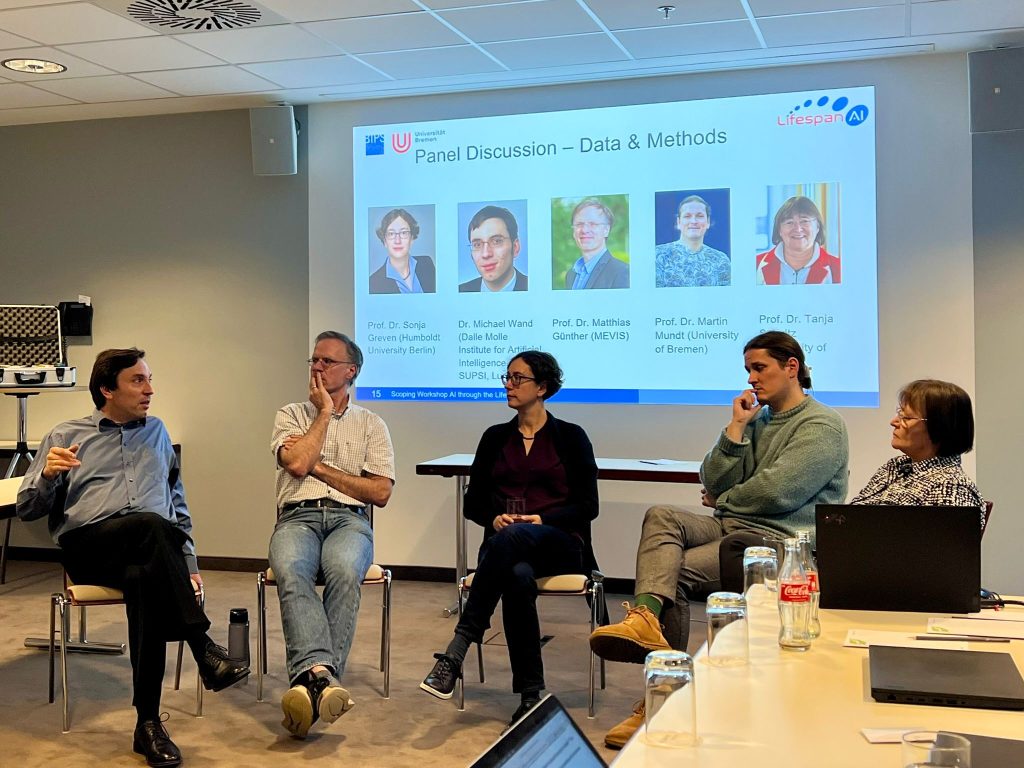
The two-day workshop, titled “Artificial Intelligence through the Lifespan,” explored which artificial intelligence methods and models need to be developed to improve healthcare through precise and personalized predictions, early prevention, and targeted, causally oriented interventions. In particular, the workshop addressed which data should be available for these purposes, how missing data must be recorded, processed, and curated, what the best strategies are for fusing data from different modalities, and what challenges arise in the process.
The main objective of the scoping workshop was to prepare the DFG follow-up proposal for the AI-FOR Lifespan AI. During the sessions, key aspects of the proposal were discussed in detail using various formats. The event’s primary focus was on the content of the proposal. Central themes included data collection and fusion, as well as AI methods for analysis and prediction. Two engaging panel discussions featuring keynote presentations by renowned guests provided scientific highlights and also offered ample material for discussion regarding the future direction of the research group.
In the first panel on the topic “Data and Methods,” Prof. Dr. Sonja Greven (Humboldt University of Berlin) and Dr. Michael Wand (Dalle Molle Institute for Artificial Intelligence USI-SUPSI, Lugano) discussed the latest methodological developments in the field of acquisition and analysis of complex multimodal biosignal and health data with Prof. Dr. Matthias Günther (MEVIS), Prof. Dr. Martin Mundt (UB), and Prof. Dr. Tanja Schultz (UB).
The second panel, titled “Interpretation and Applications,” placed a special focus on prevention and prediction in practice. It featured input from Prof. Dr. Johannes Schröder (University of Heidelberg), Prof. Dr. Christiane Thiel (University of Oldenburg), Prof. Dr. Horst Hahn (MEVIS), and Prof. Dr. Marvin Wright (BIPS). The scientific exchange on these key topics stimulated the debate and enriched the substantive discussions on strategic planning for the future of Lifespan AI.